
Coaches Trailside Webinar: Hosted by Competitive Cyclist
Watch the recording of our last webinar, focused on trailside repairs, such as the essentials to carry on a day-to-day […]

This is the first article in a two-part series on creating and using practice plans with NICA teams. It explores the benefits of practice plans and coaches’ roles in putting them to use.
Think back to your team’s last practice. What were the goals for that session? Did you achieve them? Did each activity have a specific purpose? Did you know your specific role from beginning of practice to end?
Or did you and your team just show up and “ride bikes?”
While there’s nothing wrong with unstructured time on the bike, that’s something student-athletes can and should be doing on their own. Team practices, however, can be more structured. Access to coaches, equipment, and instruction mean these times are an opportunity to develop in ways that simple saddle time can’t provide.
This is when you, as a coach, can be coaching. And if you want to be truly productive, try coaching with a plan!
Specifically, we’re talking about practice plans — actual spelled-out documents describing what should happen during a session, and why. Practice plans can be as brief or as detailed as you’d like or are able to manage, but taking time in advance to think things through and write them down comes with some real benefits:
Planning in advance lets you think about how to practice effectively. Practices can actually be counterproductive if you show up without a plan and focus on things that don’t matter or spend time on the wrong things. With a plan, you can decide what you want to achieve and match activities to that.
Any experienced coach knows that downtime can lead to boredom, distraction, and unwanted behavior. Being able to move from one activity to the next without having to figure everything out in the moment means less wasted time and fewer of the problems that come with it.
Equipment and supplies aren’t forgotten, it’s clear what setup needs to happen, everyone knows what they should be doing and when, and important things like reflection and recognition are less likely to be forgotten or cut for time.
With a little guidance from a practice plan, assistant coaches don’t have to worry about big-picture stuff or come up with activities on the fly. Which means they have the freedom to apply their own strengths and creativity to activities and better connect with their athletes. Plus, Level 2 and 3 coaches who’ve been given a plan can help run parts of practice or fill in for the head coach when they’re gone.
Yes, putting together useful practice plans is gonna take some work. In fact, coming up with a season’s worth of them will probably seem downright daunting. After a few, though, you’ll likely get the hang of it and will have established your own template for creating the rest. Best of all, you can carry them from season-to-season, and even pass them on to future leadership.
OK, you’re convinced; practice plans are the way to go. Now how do you get your hands on one?
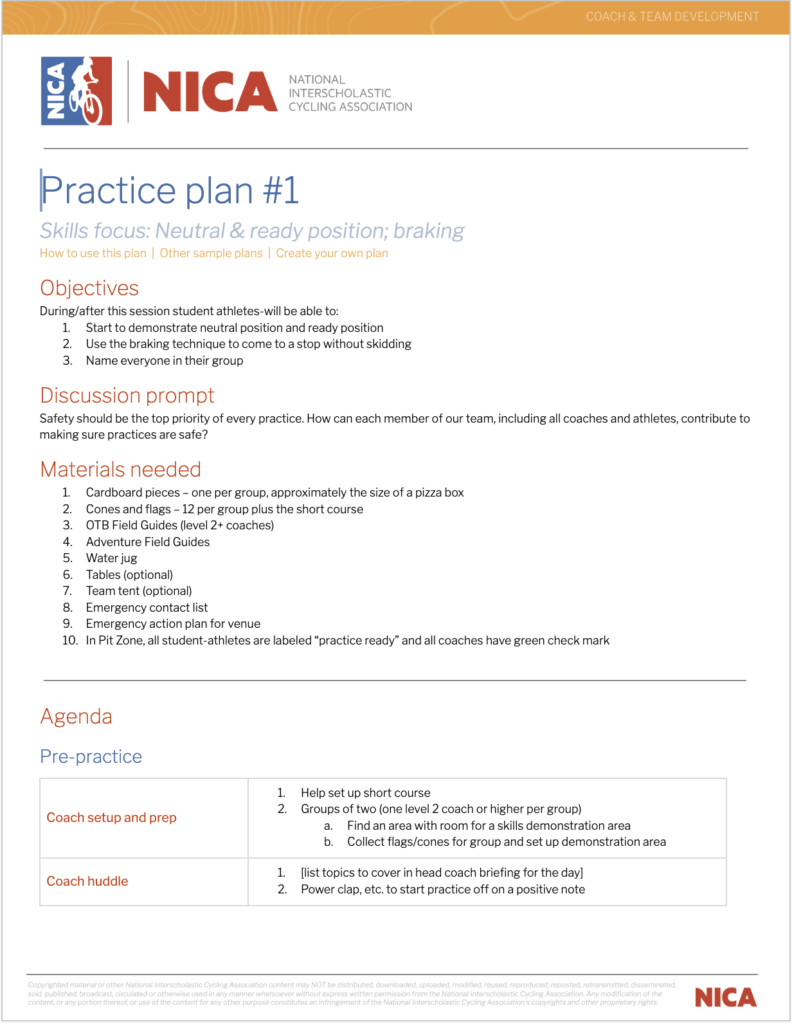
NICA’s Education Center is the perfect place to start. There, you’ll find several complete plans for early-season practices. These are great for teaching OTB 101 and 201 skills, as well as training them through a mix of games and drills. Team-building and icebreaker activities are included, too.
You can use the sample plans as they are or customize them as you’d like. Do you have easy trails suitable for practicing basic skills? Add in some trail riding. Is Space Alien Invasion your team’s favorite game ever? Swap it in. Each sample plan is an editable Google Doc ready to be tailored.
Eventually, teams will want to create their own plans to match their own unique goals, practice venues and trail systems, and athlete mix. A brand-new team with beginner-level riders will have different needs than an established team with mostly returning athletes. A team that practices on technical, rolling singletrack will practice differently than a team that only has access to a flat, open field.
That’s when a practice plan template — also available in the NICA Education Center — comes in handy. The template is a blank slate, guiding you through the process of designing plans of your own. You can use it and the sample plans as inspiration, and in an upcoming The Trailhead article, we’ll lay out what to include in every plan to maximize the results of your team’s practices.
Head coaches, when it comes to putting together a practice plan, it’s typically your responsibility as leader of the team. This is where what you’ve learned as a Level 3 coach, and the experience you’ve gained as a lead, makes you the right person for the job. Call upon what you know, and design a good mix of challenge and fun appropriate for your athletes’ skill levels.
Once that’s done, it’s time to communicate the plan to the other coaches. Make sure they have a copy of it in advance of each practice, and make sure they know what they’re to do with it.
Other coaches, your role is to read and understand the plan and make sure it gets implemented during practice. A plan is only effective if it’s truly followed. Your head coach could spend all the time in the world drawing something up, but it’d be time wasted and a missed opportunity for your athletes if not put to use.
Every coach attending a practice needs to read in advance and understand that day’s plan. They should know their responsibilities for each part of the session. Plus, they should have a copy of the plan with them during practice, whether it’s a physical printout or saved on their phone.
As for the student-athletes on the team, they don’t need to see the detailed plan. It can be helpful, though, to know at a high-level what the day’s practice holds. Consider clueing them in on practice objectives, things to focus on, changes to the typical session flow, etc. You can do this as an announcement at the beginning of practice or write them on a whiteboard next to where everyone checks in.
Having the entire team on board is a huge step toward making the most of a plan and having a meaningful practice.
Now that you understand the importance of practice plans and what your role might be, take a look at these newly updated planning resources in the NICA Education Center:
In an upcoming article on The Trailhead, we’ll dig into how to create an effective plan and what it can include to take your team to the next level of awesomeness.
This content was authored by NICA’s coach education team. NICA’s comprehensive coach education program provides new and existing coaches with the high-quality training and resources they need to be confident, competent, and empowered leaders on their youth mountain bike teams. NICA coaches not only create amazing experiences for student-athletes, they create a foundation for building healthy mountain bike communities. NICA coaches change lives!
COACH EDUCATION | PIT ZONE LOGIN | COACH REQUIREMENTS | COACH HELP DESK
NICA partners help kids gain access to a thriving and engaged cycling community.

NICA partners help kids gain access to a thriving and engaged cycling community.
Watch the recording of our last webinar, focused on trailside repairs, such as the essentials to carry on a day-to-day […]

When winning starts to feel like an expectation, the joy of racing can turn into pressure. Here’s how coaches can […]

Stop answering the same parent questions over and over. A Team Family Guidebook gives families one easy place to find […]

In this month’s The Trailhead article, we look at the power of visible female leadership and coaches from diverse backgrounds, […]